Custom components
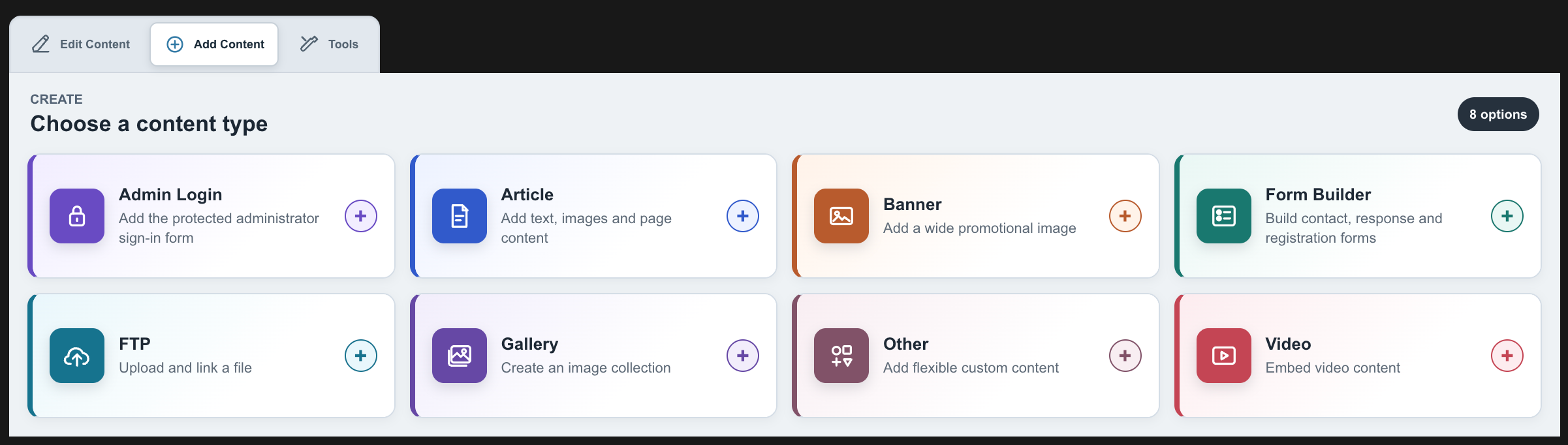
A package can declare a typed content model. RED-CMS owns the editor, placement, and access checks; the package owns its isolated business data.
RED-CMS 5.1 / Extensible content platform / 2012—2026
RED-CMS preserves the publishing structure established sites rely on while adding custom components and client-specific services as optional packages. The core stays portable; every extension is verified, permissioned, and isolated per client.
The 5.1 direction
RED-CMS separates what every installation needs—content relationships, editorial controls, layouts, permissions, and routing—from the packages, themes, data, and workflows that belong to one organization.
That boundary keeps a new capability from turning into a custom fork. A client can take only the component or service it needs, with its own version, migration ledger, settings, data, and rollback trail.
Five releases + the 5.1 build / 2012—2026
Version 5.1 advances the same compatibility-first model: extend the core with controlled packages instead of putting every future vertical into the base CMS.
Articles and page publishing
Expanded administration and content controls
Reusable layouts and broader content types
PHP modernization with legacy-content continuity
Portable themes, version history, and safer migrations
Custom-component platform, secure add-on lifecycle, and Store Lite proof
Architecture for safe expansion
PHP and MySQL manage content while file-backed themes deliver presentation. In 5.1, a package joins that structure through core-owned lifecycle, access, migration, and rendering boundaries instead of arbitrary code running inside a page.
A package can declare a typed content model. RED-CMS owns the editor, placement, and access checks; the package owns its isolated business data.
Extensions install separately for each client, validate their manifest, dependencies, checksums, and migrations, then remain disabled until an owner enables them.
Exact package permissions, CSRF, prepared database operations, state checks, and atomic rollback protect every approved change.
Performance starts with a lean PHP and MySQL core: only enabled, integrity-validated packages enter the request path.
Custom component contract
Core-owned authoring
A package can describe bounded fields and the permissions needed to use them. The core renders the administration controls, verifies a current state, and performs approved writes transactionally. It is plug-in-style expansion with an intentional installation and enablement path—not an unreviewed upload.

Store Lite / first 5.1 proof
Store Lite is the first separately distributed commerce service. In isolated browser rehearsals, it supports products, variants, add-to-cart, quantity updates, removal, and pickup or delivery orders paid on receipt. Installations that do not need commerce keep no Store Lite code, data, or tables.
Review the GitHub development recordStore Lite's hosted demo deployment and card/payment adapters remain separate release gates. Product screenshots and installation names are shown with permission; private configuration, credentials, databases, and operational data are not shown.
Content models / custom CMS / compatibility-first modernization
Your inquiry is sent privately to Oscar Rojas.